 koda
Why practise this?
Relaxed paws make wiping muddy feet, checking for a prickle and later nail care far easier for both of you.
What you need
- Practise when your dog is already relaxed, such as after a walk, lying or sitting comfortably.
- Start only with a dog who enjoys a gentle touch on the shoulder or side.
- Have small, soft rewards ready and leave space for your dog to move away.
The cue
Once a brief touch is easy, say “paws” once, just before your hand moves towards their leg.
Practise together
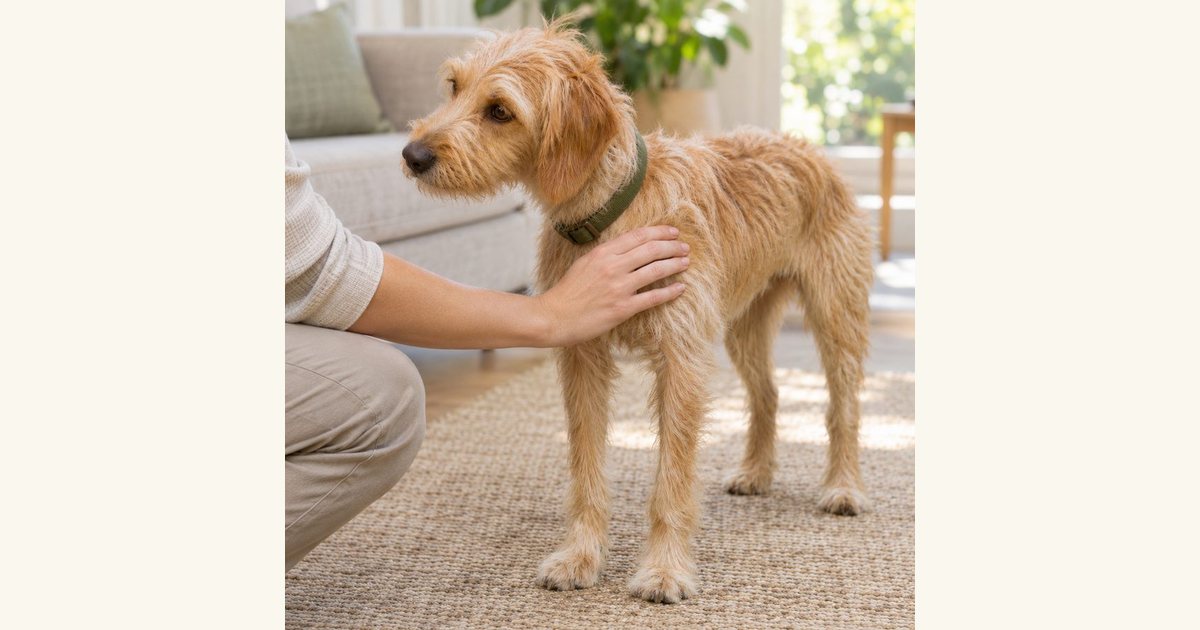
Touch your dog’s shoulder, a spot they already enjoy, for one second. Take your hand away, say “yes” and reward.
Starting somewhere easy shows you how relaxed your dog is today.
Slide your hand to the top of one front leg for a moment. Remove it, say “yes” and reward.
Keep your hand soft and flat rather than gripping.
Over a few comfortable tries, touch a little lower each time until your fingers rest briefly on top of the paw.
If your dog moves the paw away, that is a clear answer. Go back up the leg.
When that is easy, cup the paw loosely in your palm for one second without lifting. Let go first, then say “yes” and reward.
Letting go before your dog pulls away teaches them your hand always releases.
Finish after a few easy repetitions on one paw. Try another paw on a different day.
Back paws are often more sensitive. Give them their own slow start.
Make it easier
Stay higher on the leg, or reward your hand moving nearby without touching. Stop if your dog tenses, pulls away, licks their lips repeatedly or stares at your hand.
When to move on
Your dog stays loose and lets their paw rest in your hand for a second or two, and may even offer it. Then you can try a gentle lift or a quick look between the toes.
If you get stuck
Your dog mouths or licks your hand as it moves in
Keep touches shorter and place the reward on the floor afterwards so their head stays relaxed and low.
Your dog walks away after a touch
Let them go. Next time, stay on the shoulder or upper leg, which they have shown you is comfortable for now.
Front paws are fine but back paws are not
Start the back legs at the hip and build down slowly over several days.